SNHU Degree Map
Explore interactive prerequisite graphs, degree requirement structures, and course sequencing for Southern New Hampshire University programs.
What Degree Map Shows
See how a degree fits together
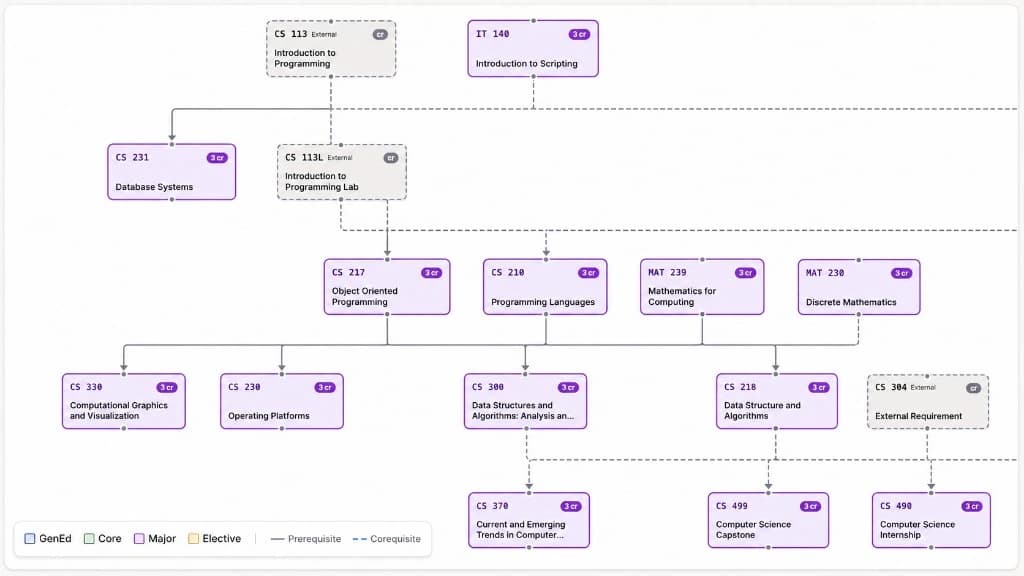
SNHU Degree Map turns published catalog requirements into an interactive visual map. Explore which courses belong to a program, how known prerequisites connect, and where transfer listings may be available.
- Follow known prerequisite and corequisite relationships.
- Understand general education, major, core, and elective requirements.
- Open course details and current transfer-equivalency listings.
Maps show known catalog relationships and are not official semester-by-semester course plans.
Popular Bachelor’s Programs
A curated selection of bachelor’s degree maps. Browse the full directory for every available program.
Business Administration (BS)
The Bachelor of Science in Business Administration emphasizes interpersonal skills, strategic problem solving, and operational principles. Students will gain a strong, comprehensive business education, becoming resourceful and creative thinkers in diverse, professional environments. A hallmark of the degree is the opportunity to apply theoretical knowledge and business skills gained in the program both inside and outside the classroom. Experiential learning opportunities such as simulations and internships are available in some cases to provide additional engagement and help students learn the importance of teamwork, adaptability, and agility in a business context. Additionally, students may benefit from valuable networking opportunities with the alumni community, industry professionals, and regional business partners. Business clubs and professional groups are available to students who would like to connect with faculty and peers and hone their skills. Through the study of problem-solving, communication, collaboration, innovation, and data-informed decision-making, students are prepared to be entrepreneurial thinkers and decision-makers in fast paced, complex environments. Students gain confidence in identifying business opportunities using current tools and technologies, leveraging data to address business needs, and collaborating effectively in a variety of situations. The program’s core courses provide a well-rounded business administration foundation, and students have the opportunity to dive deeper into specific disciplines to enhance their skill-sets and prepare them to enter a variety of professional fields. In some cases, students may also work with faculty to create a customized pathway in conjunction with the foundation that builds skills to support them in achieving their personal and professional goals. Additionally, the flexibility of elective courses offered in both online and campus based experiences allow students to further explore customizing their educational experience.
Criminal Justice (BS)
The Bachelor of Science in Criminal Justice program provides students and professionals with the practical knowledge and skills necessary to accomplish their career goals in both civilian and sworn positions in the field. The program prepares students to make ethical, evidence-based decisions as well as to identify, analyze, and approach problems creatively in their chosen profession. Students strengthen their personal and professional communication skills, critical thinking, and cultural awareness while exploring the impact of topics such as diversity and emerging technologies on criminal justice to aid in promoting positive relations and maintaining safety in the communities they serve. By expanding beyond the boundaries of a traditional degree program in criminal justice, students are exposed to current theory, discretion in decision making, emerging national and global trends, and responses to crime through field authentic learning experiences.
Computer Science (BS)
The Bachelor of Science in Computer Science at Southern New Hampshire University provides students with opportunities to develop critical technical and professional skills through work on authentic, collaborative, industry-relevant projects, as well as through the exploration of emerging tools, technologies, and environments in the field of computer science. The program curriculum provides students with a solid understanding of the fundamental programming techniques, algorithms and data structures, architecture design, networks and the mathematical computation and quantitative reasoning skills that underpin the work in the field of computer science. Students will use relevant industry/service-based projects to apply the basic concepts and theories in computer science. As a part of their coursework, students will have the ability to speak to and defend their design decisions and solutions to various audiences and in various formats. Graduates of the Bachelor of Science in Computer Science will be flexible and creative computer science practitioners prepared for various careers in both the public and private sectors, as well as for government agencies at the local and national levels.
Psychology (BA)
Southern New Hampshire University’s Bachelor of Arts in Psychology develops adaptable, emotionally intelligent, and growth-oriented professionals. Informed by the American Psychological Association (APA) Guidelines for the Undergraduate Psychology Major, this degree program provides authentic learning experiences that allow students to apply theory-based approaches in diverse and multidisciplinary environments. The program prepares students by building skills in scientific inquiry and the ability to interpret, communicate, and apply data and findings. Students strengthen their personal and professional communication skills, critical thinking, and respect for diversity, equity, and inclusivity. The program provides students with the foundational knowledge of psychology and flexible skills for entry into a variety of fields or for further study in graduate programs. As students explore the complexities of the human mind and behavior, they are empowered to use their knowledge and skills to collaborate with others in the field to encourage positive change in their lives and the world around them.